
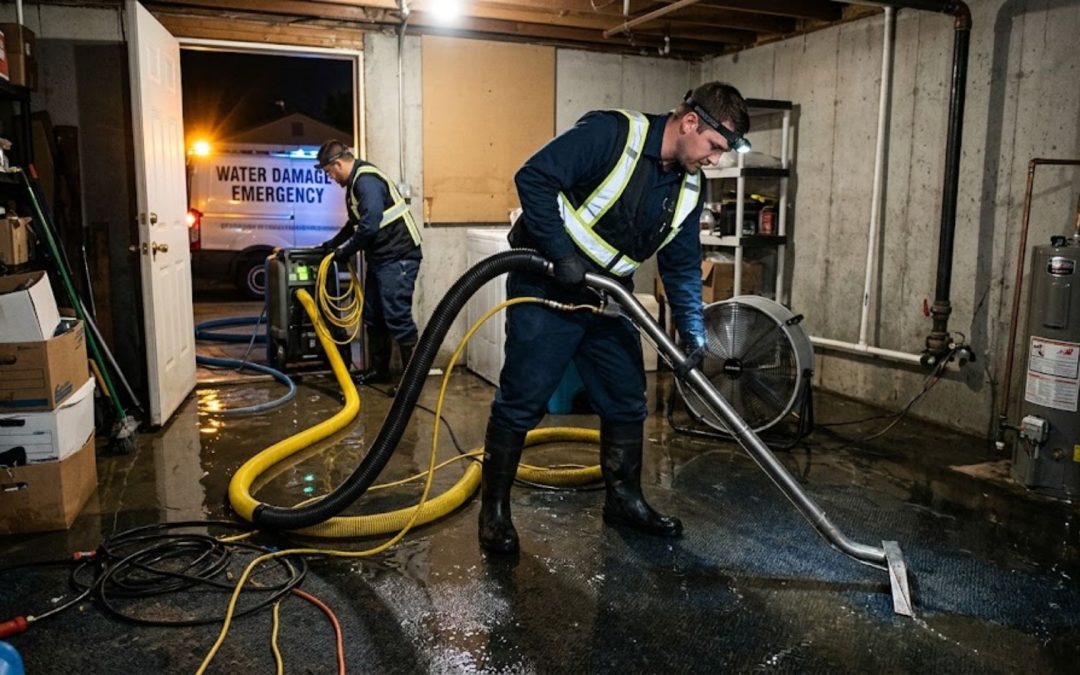
A burst supply line at midnight or a washing machine hose that lets go while you’re at work doesn’t wait for business hours, and neither should your water extraction crew. Standing water spreads fast through drywall, flooring and cabinetry, and the longer it sits, the more it costs to fix. We provide 24/7 emergency water extraction across Redlands and the surrounding Inland Empire, pulling water out before it turns a repair into a rebuild. This guide covers what counts as a true extraction emergency, how our process works, and what to do while help is on the way.
What Counts as a Water Extraction Emergency?
Not every spill needs an emergency call, but several situations do. A burst or frozen pipe, an overflowing toilet or sump pump failure, appliance leaks that go unnoticed for hours, and storm or flash-flood water entering through a foundation crack or window well all qualify. If water is actively rising, covering more than a few square feet of flooring, or has been sitting for more than a couple of hours, treat it as an emergency and call rather than waiting to see if it dries on its own.
Why Every Hour Matters After a Water Loss
Water damage doesn’t stay contained to the surface. It wicks into subfloors, baseboards and drywall within the first few hours, and mold can begin developing in as little as 24 to 48 hours in the right conditions. Extraction speed determines whether a room needs new carpet pad or a full section of flooring and drywall replaced.
That window is why we treat every call as time-sensitive rather than scheduling extraction like a routine appointment. Delaying even a single day can turn a job that would have taken a couple of drying cycles into one that requires tearing out and replacing materials that could have been saved.
How Our Water Extraction Process Works
Once we arrive, our team moves through a structured process built to stop the damage and set the space up to dry properly.
1. Inspection and Assessment
We start by identifying the water source and mapping how far it has traveled, including areas that aren’t visible from the surface, so nothing gets missed before extraction begins.
2. Water Extraction
We use professional-grade extraction equipment to remove standing water from flooring, carpet and other saturated materials as quickly as possible, reducing how much moisture has a chance to soak deeper into the structure.
3. Drying and Dehumidification
Once the standing water is gone, we bring in industrial drying systems to pull remaining moisture out of subfloors, framing and other structural materials. This step is what actually prevents mold, not just the initial extraction.
4. Cleaning and Sanitization
Water damage often carries contaminants, especially from appliance failures or backups, so affected surfaces are cleaned and treated before we consider the space restored.
5. Restoration and Repairs
Any materials that couldn’t be saved, such as soaked padding, damaged drywall or flooring, are removed and replaced so the space is back to normal, not just dry.
Signs You Need Emergency Water Extraction, Not a DIY Fix

A shop vac and some towels handle small spills, but a few warning signs mean it’s time to call in a crew instead:
- Water covering more than a small area of flooring, or still spreading after an hour
- A musty smell developing within the first day
- Water that has touched drywall, baseboards or electrical outlets
- Standing water from a source you can’t identify or stop, like a slab leak
- Any water damage in a finished basement or a room with carpet padding
What to Do While You Wait for Help to Arrive
A few steps in the first several minutes can limit how far the damage spreads:
- Shut off the water source if it’s safe and accessible to do so
- Turn off electricity to the affected area if outlets or fixtures are wet
- Move furniture, rugs and belongings out of standing water
- Avoid walking through the water more than necessary, especially with items that could carry contaminants
Common Causes of Water Emergencies We See in Redlands Homes
Redlands’ hot, dry summers followed by occasional heavy winter and monsoon-season rain put a particular strain on homes built for one climate extreme or the other. Aging supply lines and water heaters that have baked in attic or garage heat for years are more prone to sudden failure.
Older homes throughout the area, especially those with original galvanized plumbing, tend to see more slab leaks and pipe failures than newer construction. Heavy rain events can also overwhelm gutters and window wells that go unmaintained during the dry months, sending water into spaces that were never designed to handle it. Knowing what’s common locally helps us diagnose the source faster once we’re on site, which shortens the time between arrival and extraction.
Residential vs. Commercial Water Extraction in Redlands
The extraction process is similar for homes and businesses, but commercial properties often involve larger square footage, specialized flooring or equipment, and a tighter timeline to reopen. We handle both, adjusting crew size and equipment to the scope of the property rather than using a one-size approach. If the loss also involves fire damage or structural rebuilding, our reconstruction team can pick up where extraction leaves off.
Frequently Asked Questions
How fast can you get to a water emergency in Redlands?
We treat water emergencies as priority calls and dispatch as quickly as possible once we hear from you, since extraction speed has the biggest impact on how much damage spreads.
Will my homeowners insurance cover emergency water extraction?
Coverage depends on your policy and the cause of the loss, so it’s worth reviewing your policy or asking your adjuster directly. We document the damage thoroughly to support a claim either way.
Can I stay in my home during water extraction?
In most cases, yes, especially if the damage is contained to one area. We’ll let you know if drying equipment or air quality concerns mean part of the space should stay off-limits temporarily.
What if I don’t know where the water is coming from?
That’s common, especially with slab leaks or damage inside a wall. Our assessment step is built to trace the source, not just address the visible water.
How long does drying take after extraction?
Minor cases may take just a few days, while larger losses can take longer depending on how much material absorbed water and how quickly drying equipment gets moisture levels back down. We check moisture readings throughout the process rather than pulling equipment on a fixed schedule, so drying doesn’t stop before the structure actually reads dry.
Final Thoughts on Emergency Water Extraction in Redlands
Standing water gives you a short window to act before a straightforward extraction turns into drywall, flooring and subfloor replacement. Knowing the warning signs, and having a crew you can call at 2 a.m. as easily as 2 p.m., makes the difference. We provide 24/7 emergency water extraction throughout Redlands and the surrounding area, and we’re licensed, bonded and insured with a team that treats your home the way we’d want ours treated. If water is spreading through your home or business right now, call us rather than waiting to see how it looks in the morning.
